Over the years, I’ve had the opportunity to work with a lot of special education teachers, counselors, and other professionals who provide social skills instruction to students and individuals with a wide range of abilities. And one thing I’ve learned from those conversations is that there really isn’t one approach that works for everyone.
Of course, that’s probably not surprising to anyone working in special education.
We know that students learn differently. Some need more time, more repetition, or different types of support. And what might be a fairly simple skill for one student can be much more challenging for another.
But when it comes to social skills instruction, I think there’s another piece worth talking about. It’s not just how we teach a particular skill. It’s also about making sure we’re teaching skills that are meaningful to the individual we’re working with.
Individualized Social Skills Instruction Starts With the Student
Think about something as simple as greeting another person.
For one student, that might mean learning to say hello when someone enters the room. Another student might be working on acknowledging a greeting with a gesture or communication device. Someone else might already be comfortable greeting people but have difficulty knowing how to respond when a conversation continues.
All three students are working on social communication, but their instructional needs look very different.
And that’s really the point.
When we talk about individualized social skills instruction, we’re not necessarily talking about creating an entirely different curriculum for every student. We’re talking about understanding where someone is starting, identifying what would be meaningful for them to learn, and finding ways to make that instruction accessible.
Sometimes that means breaking a skill into smaller steps. Sometimes it means changing how we present the information. And sometimes it means recognizing that a student may demonstrate understanding differently than we originally expected.
This isn’t a new concept in special education. The Council for Exceptional Children’s work on High-Leverage Practices for Students with Disabilities reinforces the importance of understanding individual learning needs, adapting instruction, and using student progress to guide what we do next.
And I think those same principles are especially important when we’re teaching social skills.
Are We Teaching the Lesson or Developing the Skill?
This is something I think about quite a bit.
As educators, we have lessons to teach, goals to address, and a limited amount of time to get everything done. I understand that. And when you’re working with students who have very different needs, even deciding where to begin can be challenging.
But I think it’s worth occasionally asking ourselves a question: Are we focused on getting through the lesson, or are we focused on helping the student develop the skill?
Those two things aren’t always the same.
For example, a lesson about personal space might include a discussion, a video, and an activity. Some students may understand the concept after watching the video and talking through a few examples. Others may need to see the demonstration several times, practice with an adult, or use a visual reminder.
And for some students, the initial goal might simply be recognizing when another person needs more space.
That doesn’t mean the lesson isn’t appropriate. It means we may need to adjust what successful participation and progress look like for that individual.
I think that’s an important distinction, particularly when we’re working with students whose needs can vary so significantly.
Why Showing a Social Skill Can Be Just as Important as Explaining It
One of the things we’ve emphasized throughout the development of the Healthy Relationships Curriculum is the importance of helping students actually see what a skill looks like.
Social skills can be surprisingly difficult to explain.
Think about personal space, for example. We can tell someone to give another person enough room, but what does “enough room” actually mean? Does it look the same when you’re standing in line at a grocery store as it does when you’re talking with a close friend?
Or consider the difference between a friend and an acquaintance. Those are words we use all the time, but explaining what makes those relationships different isn’t always easy.
Using Videos, Visuals, and Demonstrations
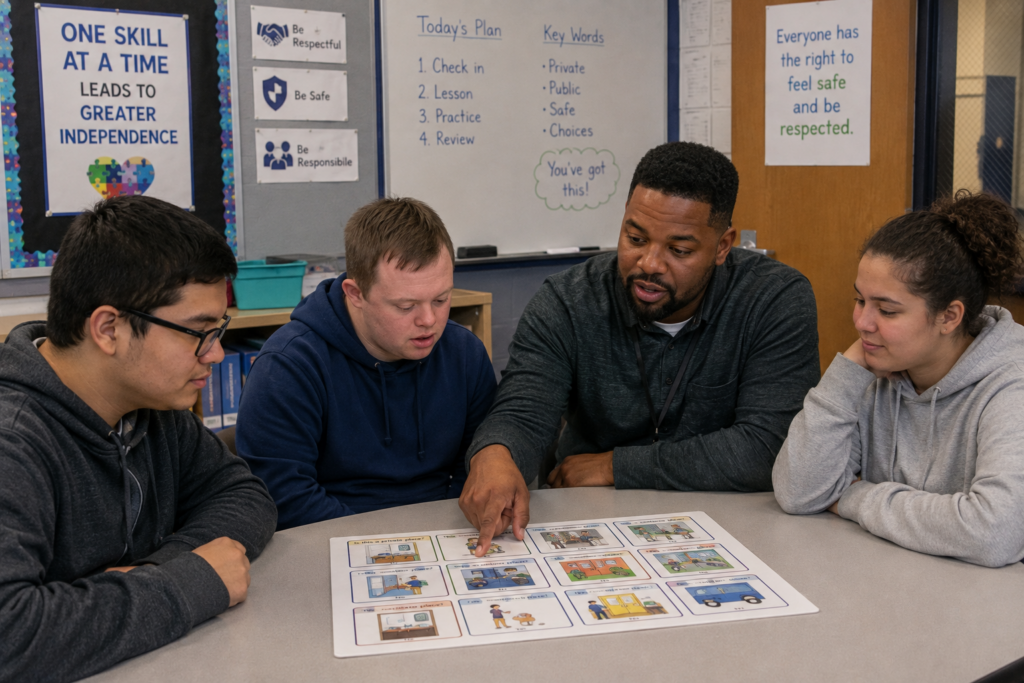
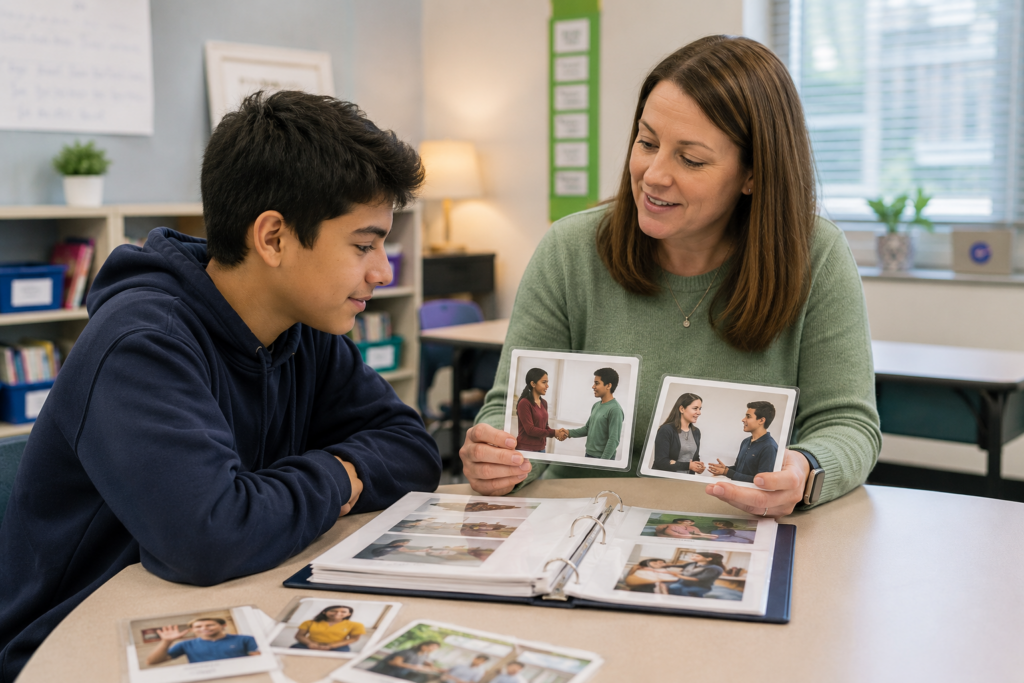
This is where videos, demonstrations, role plays, and visual supports can be particularly helpful.
Instead of relying only on verbal explanations, we can show students examples of what a situation might look like. We can stop a video, ask questions, revisit a particular interaction, or demonstrate a different response.
There’s also research supporting the use of different teaching approaches. The National Clearinghouse on Autism Evidence and Practice identifies video modeling, visual supports, and social skills training among evidence-based practices for autistic learners. While that research focuses specifically on autism, it provides useful support for considering different ways to introduce and practice social skills.
Just as importantly, we can adjust how much information we’re asking the student to process at one time.
For some students, a complete video might be appropriate. For others, focusing on one short interaction or one specific behavior may be a better starting point.
If you’re interested in seeing what this can look like, we have several Healthy Relationships sample videos available on our website. These are examples of the kinds of demonstrations educators can use to introduce or reinforce a skill.
The goal isn’t necessarily to use every instructional resource available. It’s to figure out which resources will be most helpful for that learner.
Choosing Social Skills That Matter in Everyday Life
Another consideration is deciding which social skills deserve our attention.
There are certainly some skills that most of us would agree are important, including understanding personal boundaries, recognizing safe and unsafe situations, respecting privacy, and learning how different relationships work.
But the priorities may look different depending on the individual.
A student who is beginning to participate in community activities may benefit from learning how to interact with unfamiliar people. Someone preparing for employment may need support understanding relationships with coworkers or supervisors. Another student may be working on recognizing when someone is uncomfortable or when an interaction needs to stop.
And some students may be learning foundational skills that support their ability to participate in these situations safely.
That’s one of the reasons I think social skills instruction needs to be flexible.
We don’t always have to begin with the first lesson in a curriculum and move straight through to the last. Sometimes it makes more sense to identify an immediate need, find the resources that address it, and build from there.
Of course, that doesn’t mean we should only teach skills when a problem comes up. There’s a lot of value in introducing important concepts before students encounter situations where they may need them.
And as students grow and their circumstances change, the skills we’re focusing on may need to change as well.
For educators looking at how different life and social skills fit together, our What’s Included page provides a closer look at the topics, lessons, and teaching materials available through Healthy Relationships.
What Does Progress Actually Look Like?
I think this is another area where individualized instruction becomes especially important.
When we’re teaching academic skills, we often have fairly established ways of measuring progress. Social skills can be a little more complicated.
Consider a student learning about personal boundaries.
At first, that student might be able to identify an example of someone standing too close in a picture. Later, they may recognize the same situation in a video. Eventually, they might begin responding to reminders about personal space during everyday interactions.
Those are different levels of understanding, and each can represent meaningful progress.
The same is true for learning about friendships, privacy, communication, or other relationship skills.
Not every student is going to demonstrate mastery in the same way or within the same amount of time. And I don’t think we should overlook smaller steps simply because a student hasn’t reached the final goal.
This is also why ongoing assessment and progress monitoring are important. They help us see what’s working, where a student may need additional support, and whether we need to adjust our approach.
Sometimes progress happens quickly. Other times it takes considerable repetition and practice.
Either way, we need to be able to recognize it.
And there’s another consideration. A student may demonstrate understanding during a lesson but need additional support using that same skill in another situation. We explored this in our recent article about social skills generalization in special education.
It’s a related topic, but an important distinction. Individualized instruction helps us determine how to teach the skill. Generalization helps us understand how the student begins using that skill beyond the original lesson.
Social Skills Instruction Doesn’t Have to Look the Same for Everyone
One thing I’ve appreciated about working with educators across different schools and programs is seeing how thoughtfully they adapt instruction to meet their students’ needs.
And I understand that not every classroom has the same staffing, resources, or opportunities for community-based instruction.
Sometimes the best approach is a structured lesson with a group of students. Other times, it’s taking a few minutes to revisit a concept with one student or using a situation that comes up naturally during the school day.
What matters is that the instruction has a purpose and that we’re giving students meaningful opportunities to participate.
It’s also important to remember that communication doesn’t look the same for everyone. Some students communicate verbally, while others use gestures, pictures, assistive technology, or a combination of approaches.
Those differences should influence how we teach and assess social skills, not automatically determine which skills a student should have an opportunity to learn.
And sometimes the best way to decide what works is to try an approach, see how the student responds, and make adjustments along the way.
I also think it’s important to recognize that educators don’t have to figure everything out on their own. Collaboration with other teachers, therapists, counselors, and families can help identify strategies that are meaningful for a particular student.
That’s something we encourage with Healthy Relationships as well. If you’re considering the curriculum and have questions about your students’ particular needs, you’re welcome to connect with our team. We’re educators and counselors ourselves, and we’re always happy to talk through how the resources might fit into an existing classroom or program.
How Healthy Relationships Supports Individualized Social Skills Instruction
When we developed the Healthy Relationships Curriculum, we knew it needed to work with students and individuals who have very different learning needs.
That’s why the curriculum includes more than just lesson plans.
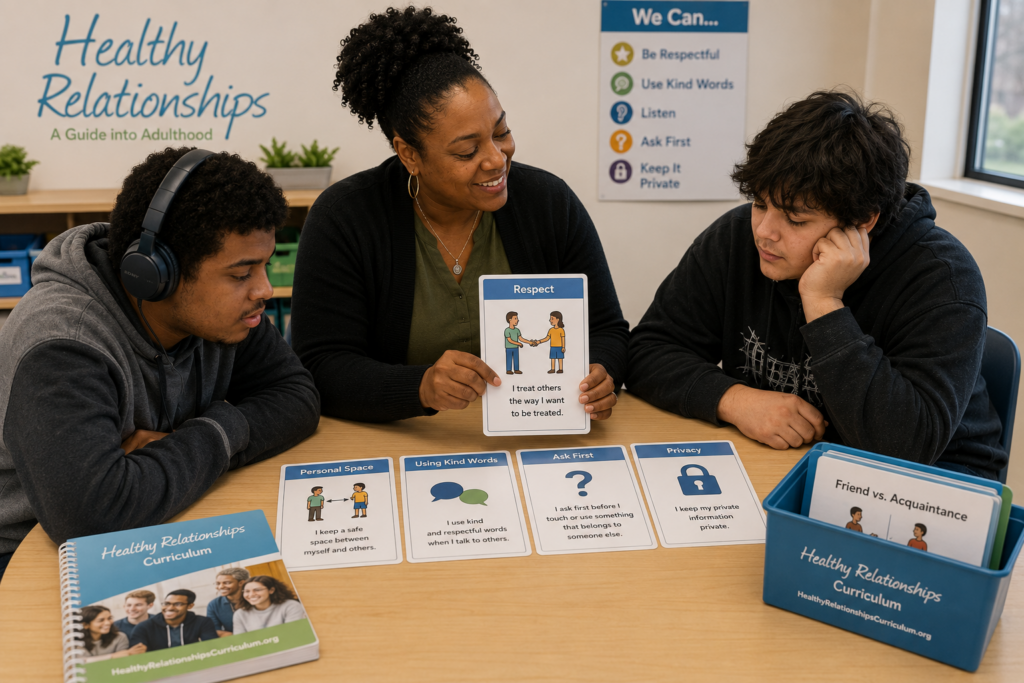
With over 250 videos, along with visuals, role plays, demonstrations, activities, and supplemental materials, educators have different ways to introduce and reinforce important life and social skills.
The curriculum also addresses a broad range of topics, from personal hygiene and privacy to friendship, communication, social boundaries, consent, and developing relationships.
But I think the most important part is that educators can adapt those resources.
A teacher might use one video as part of a full lesson, while another might use that same video to focus on a single interaction. A role play might work well for one group, while a visual activity or demonstration may be more appropriate for another.
The curriculum also includes progress monitoring tools and resources that can be shared with families and caregivers, helping reinforce instruction beyond the classroom.
And while we provide a comprehensive collection of lessons and materials, we don’t expect every educator to use every resource in exactly the same way.
In fact, one of the best ways to determine whether Healthy Relationships might work for your students is to actually explore the materials.
That’s why we encourage educators to sign up for a free trial of Healthy Relationships. It gives you an opportunity to look through the resources, explore the videos, and consider how they might fit the students or individuals you’re supporting.
We want educators to have resources they can use in ways that make sense for the individuals they’re teaching, rather than feeling that everyone needs to complete the same activities or demonstrate the same level of understanding.
A Final Thought About Social Skills Instruction
I don’t think there’s anything particularly new about the idea that students learn differently. Special education teachers have been adapting instruction to meet individual needs for a very long time.
But I do think it’s worth reminding ourselves that social skills deserve that same level of individualization.
Sometimes we’re teaching a student how to recognize a friend. Sometimes we’re helping someone understand personal boundaries. And sometimes we’re working on skills that will help an individual participate more safely and confidently in their community.
Those are all important goals, even though the instruction and outcomes may look very different.
For me, successful social skills instruction isn’t about how many lessons we complete or how quickly someone masters a particular skill.
It’s about identifying what’s meaningful for the individual, finding an approach that works, and recognizing the progress they’re making along the way.
And I think that’s something worth keeping at the center of what we do.
If you’re looking for ways to support individualized social skills instruction, take a few minutes to explore the Healthy Relationships teaching resources or watch some of our sample videos.
And if you’d like to see how the program might work with your students, you’re always welcome to start a free trial or meet with our team.
We’re happy to help you explore what’s available and determine whether Healthy Relationships might be a good fit for the individuals you serve.
Author: Rob Anderson, MSW — School Counselor