The beginning of a new school year brings new students, new goals, and new opportunities for growth. It also raises an important question: How will you know whether students are making progress? Social skills progress monitoring can help educators recognize where students are starting, celebrate growth along the way, and decide what may need to be taught next.
Healthy Relationships also uses a rating scale to help facilitators record a student’s current level of performance. This gives educators a consistent way to document change over time while still allowing individual goals to be revised for the needs of each student.
Progress can be easy to recognize when a student completely masters a skill. However, learning social and life skills does not always happen that way.
A student may move from needing five prompts to needing two. Another student may correctly identify a private place in the classroom but still need help doing so in the community. Someone learning a hygiene routine may independently complete three steps instead of one.
None of those students has completely mastered the skill.
But all three are making progress.
When educators intentionally collect information along the way, those smaller steps become easier to see. More importantly, that information can help guide what happens next.
Why Social Skills Progress Monitoring Matters
Progress monitoring should be about more than collecting numbers.
Useful information can help an educator answer important questions. Is the student learning the skill? Is the student becoming more independent? Does the skill need to be retaught? Is the student using what they learned somewhere other than the classroom?
The Council for Exceptional Children emphasizes the importance of using data to create individualized goals, monitor learning, and adjust instruction based on student needs. For students receiving special education services, progress monitoring is also closely connected to determining whether they are making meaningful academic and functional progress toward their IEP goals.
That last word matters: functional.
For many students with developmental disabilities, meaningful progress includes much more than academics. Learning may involve personal space, hygiene, friendship, safety, communication, relationships, public and private places, handling rejection, or becoming more independent in daily routines.
Those skills deserve to be monitored too.
Start With Where the Student Is Today
It is difficult to recognize growth if we do not understand where a student started.
That makes the beginning of the school year an especially useful time to think about progress monitoring.
Perhaps a student can already identify a friend but has difficulty explaining the difference between a friend and an acquaintance. Another student understands personal space when looking at a visual but struggles to demonstrate it with another person. Someone else can complete most of a showering routine but still needs several verbal prompts.
Those starting points matter.
They also remind us that students entering the same classroom do not necessarily begin in the same place. Two students may be working on the same broad skill while needing very different goals, prompts, supports, and expectations.
Effective social skills progress monitoring gives us a way to recognize those differences rather than defining success exactly the same way for everyone.
Progress Is More Than Complete Independence
We sometimes make progress harder to see because we are waiting for mastery.
Imagine a student who needs six prompts to complete a daily living task at the beginning of September. By November, the student needs only two.
Has the student mastered the task independently? No.
Has meaningful progress occurred? Absolutely.
The same thing can happen with social skills. A student who once struggled to identify an appropriate response to rejection may begin choosing a safe response during role play. Later, the student may use that response with a peer.
Each step gives us information.
That is one reason breaking larger skills into smaller, teachable pieces can be so important. As we discussed in Teach One Social Skill at a Time, smaller steps can help educators recognize what a learner already understands and what still needs additional instruction.
Progress monitoring gives us another piece of that process. If smaller steps count, we need ways to notice and document them.
Use Progress Monitoring to Decide What Comes Next
Collecting information is only useful if we do something with it.
Suppose a student consistently demonstrates a skill across several lessons. That may tell us the student is ready for a more challenging example or an opportunity to practice somewhere new.
On the other hand, data may show that a student continues to struggle with one part of the skill. Instead of moving forward simply because the class finished the lesson, an educator can revisit that concept.
That is where social skills progress monitoring becomes instructional rather than simply administrative.
The question changes from:
“Did we teach this?”
to:
“What is the student showing us about what they understand?”
That difference is important.
Sometimes the information tells us to move forward. Other times, it tells us to slow down, reteach, change an example, provide another visual, watch a video again, or give the student more opportunities to practice.
Social Skills Progress Monitoring Can Support IEP and Transition Goals
For special educators, data also has practical value beyond the individual lesson.
When a student’s social or life skill instruction connects with an IEP goal, treatment goal, transition goal, or another individualized objective, progress data can provide useful information about how that student is developing the skill.
The goal may involve communication. Another might address independence, personal safety, social interaction, self care, relationships, or community participation.
As students get older, progress toward functional and transition related goals can become especially meaningful.
Healthy Relationships includes online participant tracking and progress monitoring tools designed to help educators collect and review this information. Participant data can be recorded across classes and groups and over multiple years. Educators can also print reports that can be attached to goal sheets. The tools are designed to support IEP and treatment planning goals as appropriate for the individual learner.
Of course, a Healthy Relationships report does not replace an IEP or determine whether a particular IEP requirement has been met. Instead, it can provide another useful source of information when the skills being tracked align with a student’s individualized goals.
That distinction is important.
The goal is not more paperwork. The goal is better information about student growth.
Progress Should Be Visible
Sometimes a list of numbers does not tell the story as clearly as seeing change over time.
Healthy Relationships participant tracking tools can visually display progress through color coded graphs. Educators can follow data from the beginning to the end of a course and across multiple classes or years.
That can help make growth easier to recognize.
It may also help when communicating with families, caregivers, team members, administrators, or other professionals supporting the student.
Instead of simply saying, “They’re doing better,” an educator can have information showing where progress has occurred and where additional teaching may still be needed.
That creates a much more useful conversation.
Social Skills Progress Monitoring Should Go Beyond the Classroom
Social and life skills are not meant to stay inside a lesson.
Ultimately, we want students to use them in real situations.
A student may correctly identify personal space while sitting with a teacher. What happens in the hallway?
A student may identify public and private places using classroom examples. What happens at home or in the community?
A student may demonstrate part of a hygiene routine at school. Is the same skill beginning to appear at home?
Information from families and caregivers can help educators see a larger picture.
Healthy Relationships includes Skill Evaluations for parents and caregivers that can be shared digitally. These evaluations allow information about skills demonstrated at home and in the community to become part of the learning process. They can help identify areas of strength, skills that may need to be retaught, and potential safety concerns.
This kind of communication can also support consistency.
If the classroom is working on one concept while a caregiver is seeing something very different at home, that information matters. It may give the team an opportunity to reinforce the same skill across people and environments.
That connects directly with the importance of consistent repetition when teaching social skills.
Make the Progress Monitoring Fit the Student
No two students learn exactly the same way.
Their progress monitoring should not have to look exactly the same either.
Healthy Relationships gives educators goals and tools to begin tracking progress. However, educators can also add or revise every goal within the participant tracking tools to create individualized results. The Skill Evaluation documents used with parents and caregivers are fully revisable as well.
That flexibility matters.
Maybe the wording of a goal does not match the language used in your classroom. Perhaps a student’s IEP uses more specific language. A facilitator may want to break a skill into smaller steps. Another student may need a goal adjusted to better reflect their current level of independence.
You should not have to rebuild an entire progress monitoring system from scratch.
At the same time, you should not be forced to use wording that does not fit your students.
Healthy Relationships provides the structure while giving educators the ability to make adjustments for the people they actually teach.
Celebrate the Progress You Find
Progress monitoring can easily sound clinical.
Data. Reports. Goals. Graphs.
But behind every number is a student learning something.
A student needed less help today.
Someone recognized an unsafe situation.
A learner remembered another step independently.
A student used a social skill at home that had previously only appeared during classroom instruction.
Those moments matter.
Social skills progress monitoring can help make those successes visible. That gives educators an opportunity not only to adjust instruction but also to provide positive reinforcement when students demonstrate growth.
We should not wait until a skill is completely independent before acknowledging the work it took to get there.
Make Progress Monitoring Part of the New School Year
The first weeks of school are filled with things to establish: schedules, routines, expectations, relationships, and instructional priorities.
This is also a good time to think about how you will recognize progress.
Where is the student beginning?
What does success look like for that individual?
How will you know when less prompting is needed?
Who else sees the student use these skills?
How will that information help determine what you teach next?
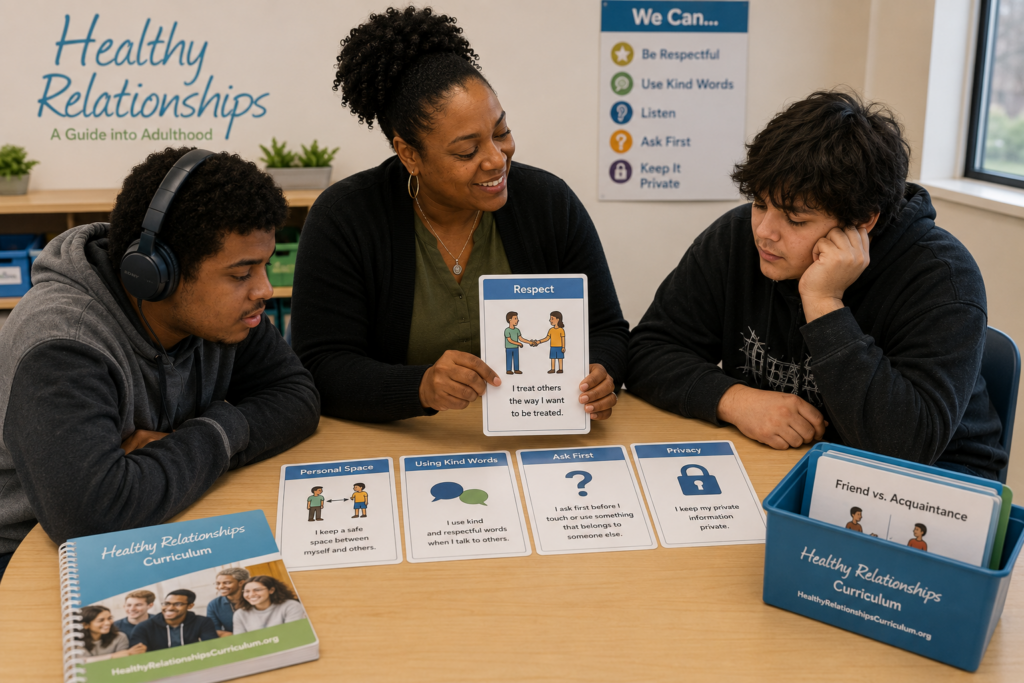
Healthy Relationships was designed to give educators tools for teaching social, relationship, safety, hygiene, and life skills while also helping them follow student growth over time.
You can explore Healthy Relationships progress monitoring tools to see participant tracking, Skill Evaluations, graphs, reports, and individualized goals.
If you would rather see the materials for yourself, start a free Healthy Relationships trial and explore the program.
You can also request a Healthy Relationships sample packet to review materials and see how lessons are structured.
And if you are thinking about a particular classroom, student population, or instructional challenge, meet with the Healthy Relationships team. We are always happy to talk through your questions and show you how the resources may fit your setting.
Because at the end of the year, the question should not simply be, “What did we teach?”
A better question may be:
“How did our students grow?”
And good progress monitoring can help us answer it.
Author: Jen Falkowski, M. Ed. — Special Education Supervisor