“Didn’t we just go over this yesterday?” It’s a question many educators quietly ask when a student struggles to recall or use a skill that has already been taught. Often, the answer isn’t simply more repetition. It’s consistent repetition.
Perhaps it’s after reviewing conversation skills again or practicing how to ask for help before an activity. Whatever the situation, it can feel frustrating when a skill that seemed understood one day appears forgotten the next.
Those moments often lead us to believe students simply need more repetition. While repetition is certainly important when teaching social skills, the real difference often comes from consistent repetition.
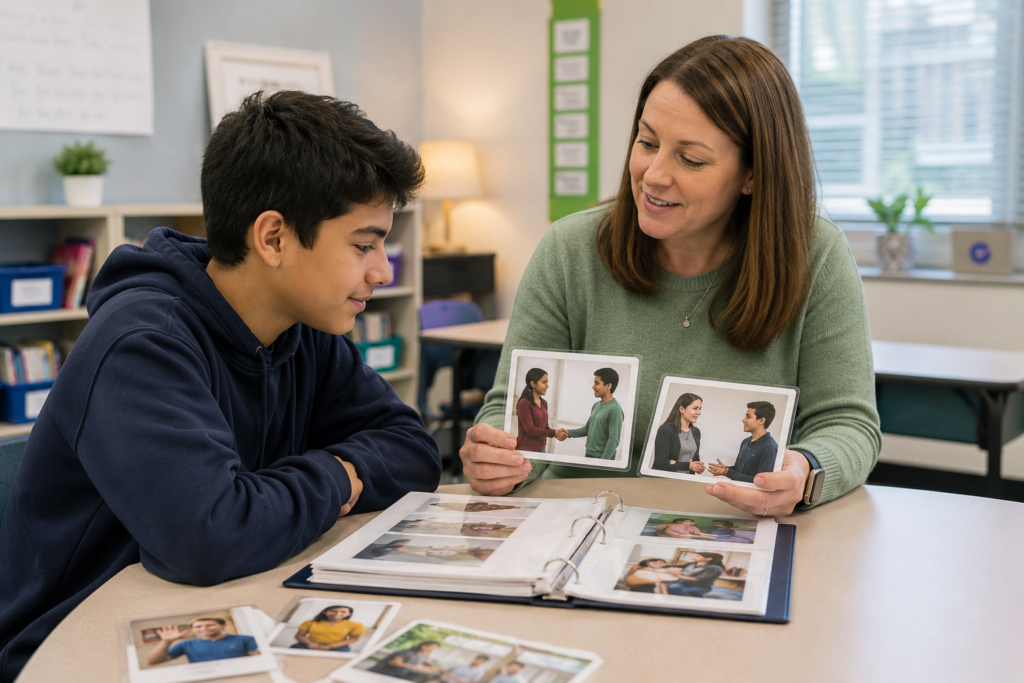
Consistent repetition means students experience the same concepts through shared language, familiar visuals, instructional videos, demonstrations, role plays, and meaningful opportunities to practice across different environments.
Students with developmental disabilities, autism, and other learning differences frequently need repeated opportunities to learn, practice, and apply new skills. Lasting learning doesn’t happen because we say the same thing over and over again. It happens because students experience familiar concepts consistently across the people, places, and instructional materials that support them.
That’s the difference between repeating yourself and teaching for lasting learning.
Repetition Isn’t the Same as Repeating Yourself
When educators hear the word repetition, many picture saying the same sentence again and again.
“Remember your personal space.”
“Use your inside voice.”
“Wait your turn.”
Although reminders have their place, repetition involves much more than verbal reminders. Effective repetition gives students multiple opportunities to experience the same concept in meaningful ways.
A student may first learn a skill during direct instruction. Later, they may watch a video demonstrating that same concept. Next, they might discuss it with classmates, practice it during a role play, receive feedback from a teacher, and eventually apply it naturally during lunch, recess, or a community outing.
Each of those experiences reinforces the same lesson while helping students understand how it applies across different situations.
Repetition isn’t simply repeating the same words over and over again.
Repetition is giving students multiple opportunities to experience the same concept through visuals, videos, demonstrations, role plays, discussion, and real-world practice until they truly make it their own.
Why Consistent Repetition Is So Powerful
Many learners naturally recognize that different adults can explain the same idea in different ways. They understand that a teacher, counselor, speech language pathologist, and parent may all use different examples while still teaching the same concept.
For many students with developmental disabilities, that connection isn’t always automatic.
Imagine one professional teaches personal space using circles on the floor. Another uses bubbles. A third introduces an entirely different visual. A family member explains it using different language at home.
While every adult has good intentions, students who struggle with generalization may believe they’re learning four different concepts instead of one.
Rather than reinforcing learning, we’ve unintentionally introduced competing instruction.
That’s why consistent repetition is so powerful. When every adult reinforces a concept in a familiar way, students spend less energy decoding different teaching styles and more energy learning the skill itself.
Students aren’t simply hearing a concept more often. They’re experiencing the same concept through familiar language, visuals, demonstrations, and expectations no matter who is teaching it.
Consistency reduces confusion. It builds confidence. Most importantly, it allows students to focus on learning the skill instead of trying to figure out whether they’re learning something entirely new.
Consistent Repetition Helps Students Generalize Skills
One of the greatest challenges many students face is generalization.
Learning a skill during a lesson doesn’t automatically mean that skill will transfer to the hallway, cafeteria, workplace, community, or home.
Generalization develops gradually through repeated success across different environments. Consistent repetition provides the bridge between those environments by helping students recognize that the same skill applies wherever they go.
The key is that the environments may change, but the instructional foundation remains familiar.
Students benefit from practicing conversation skills in the classroom, then during lunch, then during community outings, and eventually during employment experiences. Each opportunity expands where the skill is used without changing how the skill is taught.
That consistency helps students recognize,
“I’ve seen this before.”
Instead of,
“This is something completely different.”
True generalization isn’t about constantly introducing new teaching methods.
It’s about consistently reinforcing the same concept until students recognize it wherever it appears.
Everyone Contributes to Consistent Repetition
Teaching social skills is rarely the responsibility of one educator.
Throughout a school day, students may learn from classroom teachers, special education teachers, school counselors, speech language pathologists, occupational therapists, behavior specialists, paraprofessionals, administrators, and families. Every interaction becomes another opportunity to reinforce the same concept.
Imagine the impact when every one of those adults reinforces the same skill using familiar language, shared visuals, consistent demonstrations, and similar expectations.
Instead of each professional relying on their own collection of materials developed over many years, the instructional team works from the same playbook.
Students begin recognizing familiar visuals.
They hear consistent language.
They practice similar role plays.
They receive reinforcement that connects back to previous learning.
Every interaction becomes another opportunity to strengthen understanding rather than introducing unnecessary variation.
That’s what consistent repetition looks like.
What Consistent Repetition Looks Like in Practice
Consistent repetition doesn’t mean lessons become boring.
Instead, it means students encounter familiar concepts through engaging experiences that build on one another.
A lesson might begin with explicit instruction.
Students may then watch a short video demonstrating the skill.
Next, they participate in a role play.
Later, the same visual is referenced during lunch.
The counselor reviews the concept before a community outing.
Families reinforce the same expectations at home using the same visual supports.
Each experience feels connected.
Each adult reinforces the same message.
Each opportunity strengthens learning.
This is consistent repetition in action.
This approach aligns with evidence-based instructional practices that emphasize explicit instruction, modeling, guided practice, and repeated opportunities for application. Resources from the IRIS Center at Vanderbilt University highlight the importance of structured, intentional instruction and repeated practice when teaching students with diverse learning needs.
Building Consistent Repetition Across School and Home
One of the most effective ways to strengthen learning is by extending instruction beyond the classroom.
When families understand the same language, visuals, and expectations students experience at school, learning becomes continuous instead of isolated.
A conversation about voice volume doesn’t end when dismissal bell rings.
A lesson about healthy friendships continues during community activities.
Personal space becomes something students recognize whether they’re in the classroom, on the bus, at a restaurant, or spending time with family.
This shared understanding creates more opportunities for success because students aren’t constantly adjusting to new instructional approaches.
Instead, they’re building confidence through familiar experiences.
Healthy Relationships Was Designed Around Consistent Repetition
Consistent repetition isn’t something that happens by accident.
It requires intentional planning and shared instructional tools.
That’s one of the reasons Healthy Relationships was designed to provide educators with common lessons, visuals, videos, demonstrations, role plays, and instructional materials that can be used across classrooms and professional disciplines.
Whether instruction comes from a teacher, counselor, speech language pathologist, paraprofessional, administrator, or family member, students continue encountering familiar concepts presented in consistent ways.
That consistency helps reduce confusion while supporting meaningful learning across settings.
See what’s included in Healthy Relationships.
If you’d like to experience how consistent repetition is built throughout the curriculum, start a free trial and explore the lessons, visuals, videos, and instructional resources for yourself.
You can also watch our sample videos to see how familiar instructional strategies are reinforced throughout the curriculum.
Every school is unique, and every team approaches instruction differently. If you’d like to talk about how consistent repetition can strengthen social skills instruction within your classrooms, schedule a free meeting with our team.
Lasting Learning Takes More Than Repetition
The next time you find yourself thinking,
“Didn’t we just teach this yesterday?”
remember that the answer usually isn’t simply repeating the same words one more time.
Students learn best when instruction is consistent, intentional, and reinforced across the people, places, and experiences that make up their everyday lives.
When educators, related service providers, administrators, and families work together using shared language and common instructional tools, repetition becomes something much more powerful.
It becomes understanding.
It becomes confidence.
It becomes independence.
Most importantly, it becomes lasting learning that students can carry far beyond the classroom.