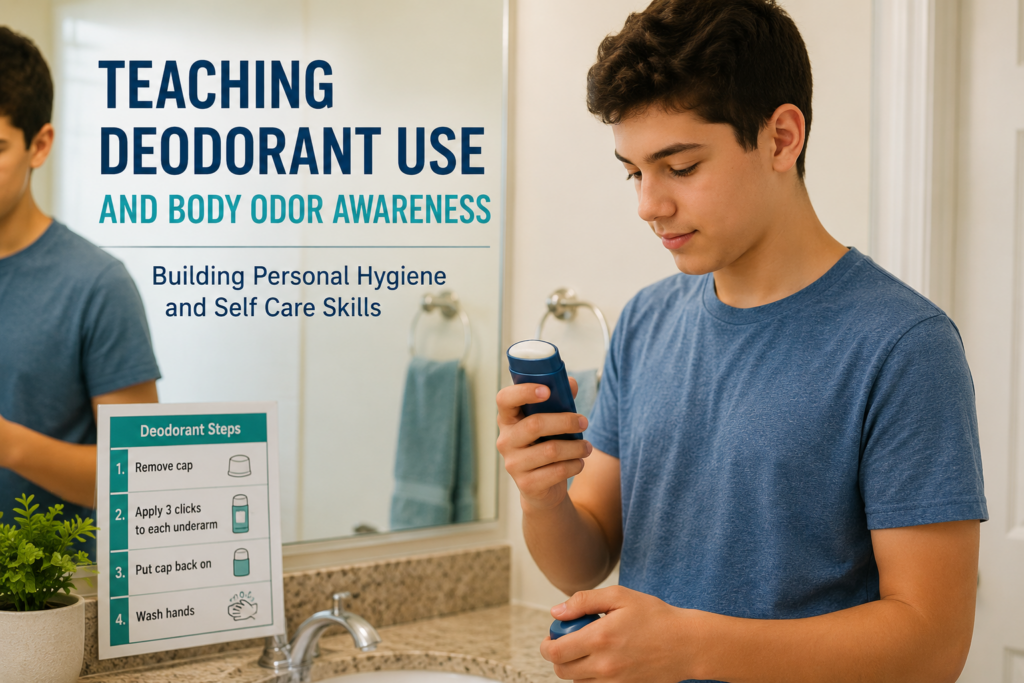
For many educators, therapists, and families, teaching personal hygiene can be one of the most sensitive daily living skills to address. Questions about deodorant, body odor, and self care often become more common as students enter puberty, participate in physical education classes, or begin preparing for greater independence.
While deodorant may seem like a simple part of a morning routine, many individuals with developmental disabilities need direct, structured instruction to understand not only why deodorant is important, but also how to use it effectively.
Teaching deodorant use is about much more than preventing body odor. It supports confidence, healthy relationships, social success, employment readiness, and independence.
Why Deodorant Can Be Difficult to Teach
Many of us assume that using deodorant is a skill people naturally pick up as they grow older. In reality, many learners benefit from explicit instruction.
Educators are often surprised to discover that a learner who says they use deodorant has never actually been taught each step of the process. Other learners may have been introduced to deodorant years earlier, but they were not yet developmentally ready to understand, retain, or consistently apply the information.
Observation does not always lead to learning.
One of the most important things educators can do is slow the process down and recognize that what seems obvious to us may need to be taught in clear, concrete, and respectful ways.
When Should Educators Begin Teaching Deodorant Use?
Many families and educators wait until body odor becomes a concern before beginning instruction.
In many cases, it is more effective to begin teaching deodorant use as students begin experiencing puberty or before increased physical activity becomes part of their daily routine.
Starting early allows learners time to develop a consistent habit before social situations become uncomfortable or embarrassing.
Just as importantly, instruction should always match the learner’s developmental readiness rather than focusing only on chronological age. Revisiting a skill later is not “starting over.” It is recognizing that the learner may now be ready to understand and apply the information successfully.
Teaching Personal Hygiene Through Daily Routines
One advantage of teaching deodorant use is that it naturally fits into routines many learners already have.
Morning routines.
After showering.
Before getting dressed.
After physical activity.
Because deodorant is typically used at the same point each day, educators and families have opportunities to build consistency through repetition and predictable schedules.
When routines remain consistent across school, home, and community environments, learners are often more successful in maintaining the skill independently.
Common Challenges When Teaching Body Odor Awareness
Teaching deodorant is not simply about handing someone a product.
Educators may encounter challenges such as:
- Limited awareness of body odor.
- Sensory preferences related to smells or textures.
- Difficulty remembering when deodorant should be used.
- Challenges completing every step of the routine independently.
- Limited understanding of why deodorant is important in different social settings.
These challenges should never be viewed as a lack of motivation. More often, they highlight the need for explicit instruction, repetition, visual supports, and opportunities for practice.
Seeing a Hygiene Lesson in Action
Sometimes it helps to see what structured instruction actually looks like.
Healthy Relationships includes practical lessons that help educators teach personal hygiene skills using clear language, visual supports, discussion, and age-appropriate instruction.
Keeping Clean/Showering Lesson
How Healthy Relationships Supports Personal Hygiene Instruction
Healthy Relationships was designed to help educators teach topics that are often uncomfortable to discuss but are essential for independence.
Rather than expecting educators to gather materials from multiple sources, Healthy Relationships brings instruction together in one comprehensive curriculum.
The program includes:
- Structured lesson plans
- Age-appropriate instructional videos
- Visual supports
- Professional development
- Assessment tools
- Progress monitoring
- Home connection materials
- Resources that support consistent instruction across school, home, and community settings
See what’s included in Healthy Relationships
One of the strengths of Healthy Relationships is helping educators feel confident teaching these important life skills while giving learners respectful, age-appropriate instruction that promotes long-term independence.
Learn More About Healthy Relationships
If you’re wondering whether Healthy Relationships might be a good fit for your classroom, school district, therapy program, or organization, we invite you to learn more about how the curriculum supports relationship skills, safety education, personal hygiene, independence, and daily living skills.
Explore the Curriculum for Yourself
The best way to understand Healthy Relationships is to experience it firsthand.
Start a free trial and explore lessons, videos, visual supports, assessments, and teaching resources designed specifically for educators, therapists, and families supporting individuals with developmental disabilities.
Author: Jen Falkowski, M. Ed. — Special Education Supervisor
Healthy Relationships is used by educators, therapists, schools, residential programs, and service providers across 43 states to teach safety, relationships, independence, and daily living skills to individuals with developmental disabilities.