A few weeks into a new school year, educators begin learning a lot about their students. You may already know which skills a student can explain or demonstrate during a lesson. Now you may be noticing something else. Generalization in special education can become a challenge when a student knows a skill in one situation but struggles to use it with different people, in different places, or during everyday life.
Maybe a student can identify appropriate personal space during a classroom lesson but stands too close to peers in the hallway.
Perhaps they know the steps for brushing their teeth but need much more support completing the routine at home.
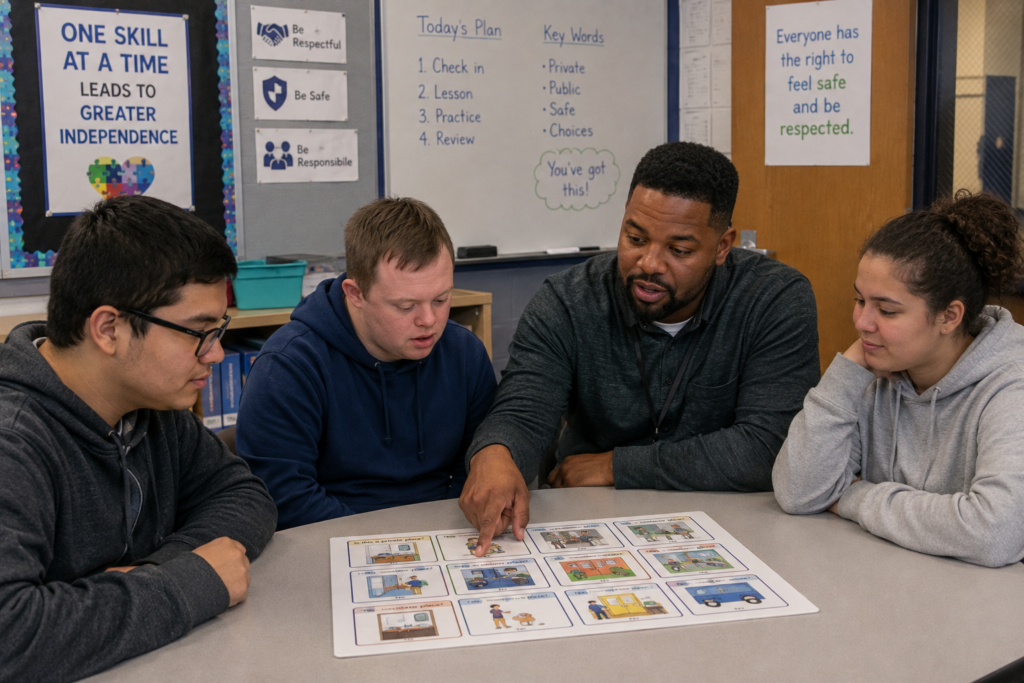
A student may correctly identify public and private places during a lesson but struggle when they encounter a new setting.
They learned the skill.
So why aren’t they using it?
The answer may have less to do with whether the student learned the skill and more to do with whether they have learned where, when, and how to use it.
What Is Generalization in Special Education?
Generalization happens when a learner can use something they have learned beyond the original teaching situation.
The Institute on Community Integration at the University of Minnesota identifies helping students maintain and generalize new learning across time and settings as an important special education teaching practice. Their guidance explains that educators can use different settings, materials, and examples to help students demonstrate skills beyond an individual lesson or unit.
That distinction matters.
Answering a question correctly during a lesson tells us something important about what a student understands. However, the ultimate goal is usually bigger.
If we teach personal space, we want the student to use appropriate personal space with different people.
Hygiene instruction should eventually become useful during actual hygiene routines.
Communication, safety, friendship, and relationship skills should also help students recognize what to do during real interactions.
Learning the skill is important.
Using the skill is where independence begins.
If you’re already thinking about skills your students need to practice in different situations, you can explore free Healthy Relationships lessons and resources right now. These resources provide examples of how social and life skills can be broken down and taught in concrete ways.
Knowing the Answer Is Different From Using the Skill
Teachers see this all the time.
A student may answer every question correctly about who is a friend, acquaintance, or stranger. Then someone they barely know starts a conversation in the community, and suddenly those categories become harder to apply.
Another student may demonstrate an appropriate voice volume during practice. Ten minutes later, the classroom becomes exciting and that voice volume disappears.
This does not necessarily mean the lesson failed.
It may mean the student needs more opportunities to connect what they learned with new situations.
That’s one reason generalization in special education deserves intentional attention. We cannot always assume that because a learner demonstrates a skill once, they will automatically recognize every other situation in which it applies.
Instead, educators can help build those connections.
Change the Example Without Changing the Skill
One way to encourage generalization is to vary what surrounds the skill.
Suppose you are teaching personal space.
You might begin with a visual that shows an appropriate distance between two people. Next, students could watch a video of people demonstrating personal space. They might practice with a teacher and then with a peer.
Later, the same concept can appear in another setting.
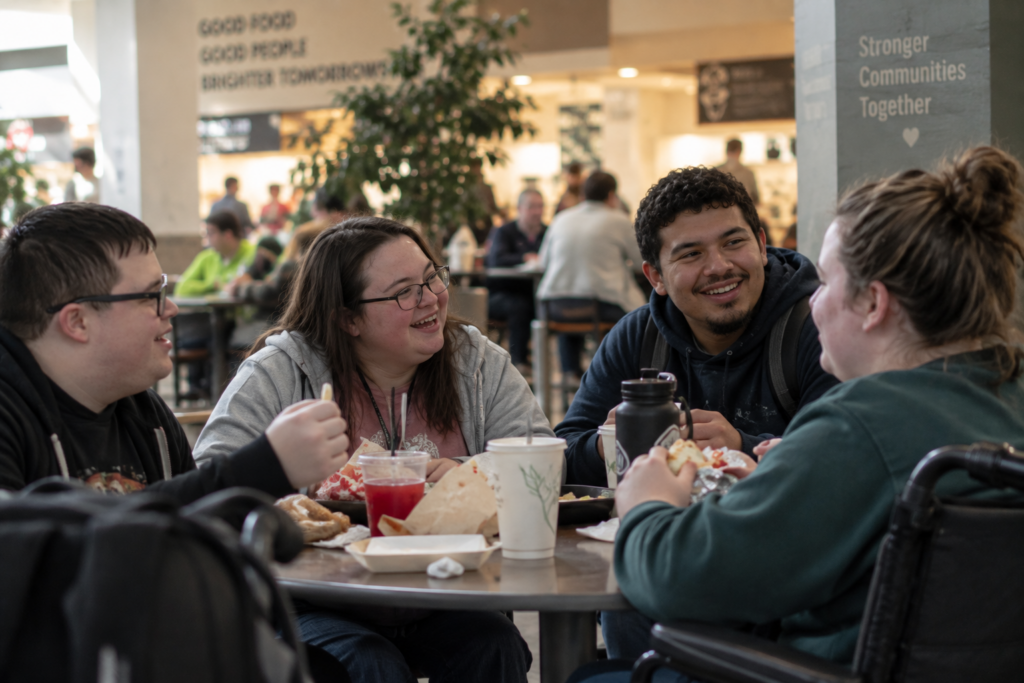
What does personal space look like in the cafeteria?
What about standing in line?
Does it change when you are talking with a family member?
What happens on a crowded bus?
The examples change, but the core concept remains recognizable.
Healthy Relationships was designed around this type of repeated learning. Lessons connect with visual supports, videos, demonstrations, role plays, scenario cards, discussions, and opportunities for practice.
You can see what’s included in Healthy Relationships to explore how these instructional pieces work together rather than asking educators to build each resource separately.
Generalizing Skills With Different People
Sometimes the setting stays the same while the person changes.
A student may communicate very successfully with a teacher they know well. Talking with a peer, substitute teacher, employer, community member, or unfamiliar adult may be different.
That is another opportunity to think about generalization in special education.
Educators can intentionally vary who participates in practice.
A role play might begin with a familiar teacher. Later, another staff member can participate. Students can practice together when appropriate. Families and caregivers can also help learners recognize the same concepts outside school.
This does not mean every person needs to teach the skill in exactly the same way.
However, some consistency can help.
We recently explored why consistent repetition can support social skills instruction. When students encounter familiar concepts, visuals, and language across different learning experiences, they have another opportunity to recognize that the same skill still applies.
Generalizing Skills Beyond the Classroom
Eventually, many skills need to leave the lesson.
Hygiene skills need to work in bathrooms and at home.
Conversation skills need to work during actual conversations.
Community safety skills need to work in the community.
Relationship skills need to help learners navigate real relationships.
That transition can be challenging because real life is less predictable than a classroom example.
People say things differently. Environments change. Distractions happen. A situation may look similar to one discussed during a lesson without being exactly the same.
This is why practice matters.
It also explains why teaching materials should provide more than information. Learners need opportunities to see a skill, talk about it, practice it, make mistakes, receive feedback, and encounter it again.
Healthy Relationships brings those opportunities together through lessons, visual supports, videos, role plays, activities, and opportunities to practice concepts in different ways.
Use Visuals and Videos to Build Connections
A learner does not have to experience every possible situation before being prepared for it.
Visuals and videos can bring more examples into instruction.
A picture can make an abstract idea easier to see. A video can show how a concept might look when real people use it. Then discussion and practice can help the student connect that example with their own life.
Our article about visual supports for special education explores how visuals can make social, hygiene, safety, relationship, and daily living concepts more concrete.
We have also looked at using videos to teach social skills and why seeing a skill modeled can give learners another way to understand what educators are describing.
You can also explore free sample materials and videos before deciding whether the full Healthy Relationships resources are right for your students. Seeing the materials gives you a much better sense of how they can fit into actual instruction.
Look for the Skill Where It Actually Matters
If we want students to use skills beyond instruction, we also need to look for progress beyond instruction. Generalization in special education becomes easier to understand when we look at where a skill is happening and where a student still needs support.
A student may perform beautifully during a role play and still need support elsewhere.
That information matters.
Healthy Relationships includes progress monitoring tools that can help educators document skill development over time. Information from families and caregivers can also help educators understand whether a student is beginning to use a skill outside the original teaching environment.
Our recent article about social skills progress monitoring looks more closely at why smaller changes matter and how educators can use information about student performance to decide what to teach next.
Perhaps a student understands the concept but needs another setting.
Maybe they need another person.
Perhaps the visual needs to stay available longer.
The goal is not simply to document that generalization has not happened yet.
The information should help us decide what opportunity the learner needs next.
Generalization in Special Education Takes Time
It can be tempting to think that once a student demonstrates a skill, we should move on.
Sometimes that is appropriate.
Other times, success during instruction is the beginning of the next stage of learning.
A skill may need to be revisited with new examples, people, materials, or environments. The amount of practice will also look different for every learner.
That does not make the original instruction unsuccessful.
Instead, it reminds us that meaningful learning is not always measured by whether someone can give the correct answer.
The bigger question is whether that knowledge becomes useful.
You Don’t Have to Build Every Practice Opportunity Yourself
Helping students generalize skills takes creativity.
It also takes resources.
Teachers already spend tremendous amounts of time planning, adapting, documenting, communicating, and responding to individual student needs. Creating a new visual, scenario, video, role play, activity, and progress monitoring tool for every skill should not become another full-time job.
Healthy Relationships brings those pieces together.
Educators can find structured lessons, visual supports, videos, role plays, demonstrations, family resources, progress monitoring tools, and different ways to practice social and life skills.
But you do not have to take our word for it.
You can read what educators and professionals around the country are saying about Healthy Relationships and how they are using the resources with their students.
Hearing from another teacher or professional can be especially helpful when you are trying to decide whether a resource will work in your own classroom, school, or organization.
See Whether Healthy Relationships Fits Your Students
You don’t have to decide whether Healthy Relationships is right for your classroom based only on a website description.
Try it.
You can explore free sample materials, including sample lessons and visual resources.
You can also start a free trial and begin exploring the materials with the learners you actually support.
If you would rather have materials to review with your team, you can request a sample packet.
If you have questions about a particular student population, setting, or instructional need, you can also meet with our team and talk through what you are trying to teach.
Help Students Use What They Know
Teaching a student a new skill matters.
Helping them recognize when and where to use it matters just as much.
Generalization in special education asks us to look beyond whether a student can demonstrate something during instruction. Can they use it with another person? In another place? After some time has passed? When the situation looks a little different?
We do not have to create every possible real-life situation inside a classroom.
We can provide variety and use visuals and videos.
Different examples can help learners recognize the same skill in new situations.
Practice can include different people and settings.
Families can help reinforce learning outside school.
Progress across settings can show us where additional support may be helpful.
Most importantly, we can continue helping learners connect what they know with the lives they are actually living.
Because the goal is not simply for students to learn a skill.
The goal is for that skill to become useful.
Author: Rob Anderson, MSW — School Counselor