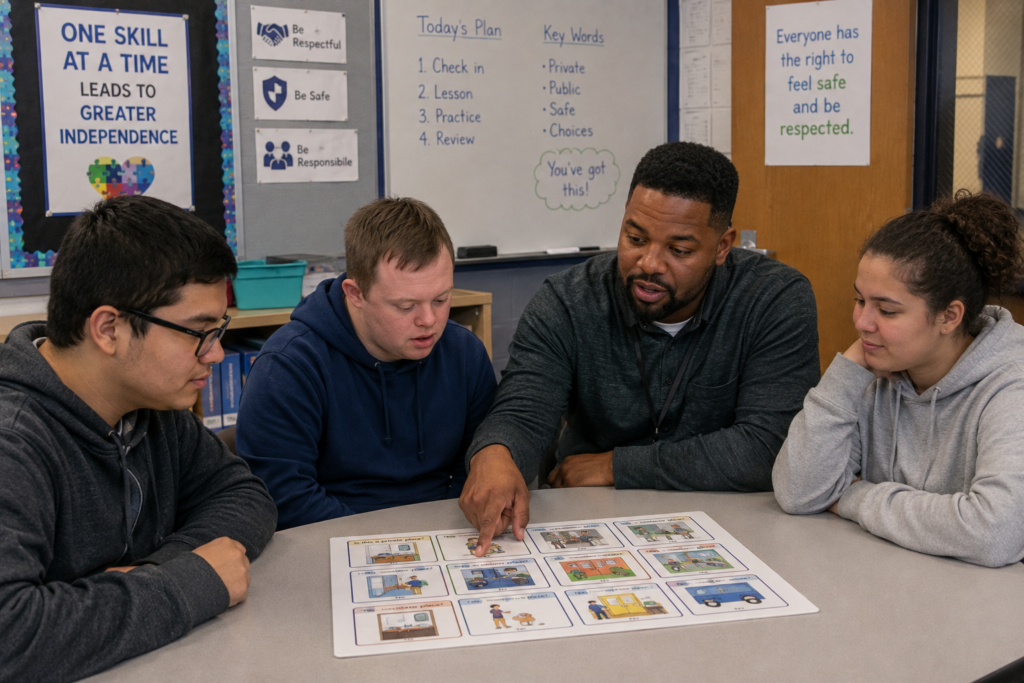
A school day can involve far more than academic instruction, including opportunities to practice daily living skills. Learners may need to organize belongings, communicate a need, manage personal responsibilities, follow a schedule, or navigate an unfamiliar situation.
For educators and support professionals, these everyday moments can provide opportunities to teach skills that connect directly to a learner’s needs, routines, and goals. The challenge is knowing which abilities to prioritize and how to make instruction useful beyond the lesson itself.
A learner does not need to perform every routine independently for instruction to have value. Greater participation, better decision-making, fewer reminders, or knowing when to seek assistance can all represent meaningful growth.
The most effective instruction starts by asking what the learner needs to participate more fully in the situations that matter to them.
Everyday Tasks Can Teach More Than One Skill
Consider what happens when a learner prepares a simple snack. The activity may involve reading directions, gathering ingredients, following a sequence, handling materials safely, communicating with another person, and cleaning the workspace afterward.
One activity can therefore provide practice in several areas of functioning.
Research on adaptive behavior among individuals with intellectual and developmental disabilities highlights the connection between functional abilities and everyday participation. These abilities can influence how people manage responsibilities and interact with their environments. Research on adaptive behavior and developmental disabilities
That broader perspective can help professionals think beyond isolated tasks. Rather than asking whether a learner has mastered one activity, educators can consider which skills they are practicing and how those skills connect to situations they encounter.
For example, a snack preparation activity may create opportunities to practice communication, sequencing, safety awareness, or decision-making, even when food preparation itself is not the instructional focus.
Can the learner contribute to a routine? Can they communicate a preference? Can they recognize when something is unsafe?
Those abilities can support participation well beyond a single classroom activity.

The Routine Can Reveal Where Support Is Needed
Observation can tell professionals more than a skills checklist alone.
Watch what happens when a learner encounters a familiar responsibility involving daily living skills. Do they know what materials to gather? Can they remember what comes next? Do they recognize when something has gone wrong? Can they recover when the routine changes?
Imagine a learner who consistently arrives at class without the materials needed for an activity. The problem may appear to be organization, yet several factors could be involved. Perhaps the learner does not understand the schedule, cannot remember which materials are required, or has difficulty transitioning between activities.
Each possibility calls for a different response.
Taking time to understand the situation allows educators to target the actual barrier rather than adding unnecessary instruction.
What Makes a Task Hard for This Learner?
Two students can encounter the same activity and experience completely different challenges.
A learner may understand how to prepare a meal but struggle to sequence the steps. Another may follow the sequence but have difficulty handling certain utensils. Someone else may complete the task successfully with familiar staff yet hesitate when another person gives the directions.
Environmental demands can change the experience too.
The Centers for Disease Control and Prevention describes developmental disabilities as conditions that can affect physical, learning, language, and behavioral areas, with potential effects on everyday functioning. CDC developmental disabilities research and data
For educators, that means instructional planning should account for more than whether a learner knows the correct response.
Communication style, sensory preferences, motor abilities, attention, memory, and familiarity with the environment can all influence performance.
Sometimes the skill is there. The conditions around it need to change.
Make the Next Step Easier to Recognize
Some learners benefit when an entire responsibility is made more predictable.
Visual schedules, photographs, written directions, demonstrations, and checklists can show what needs to happen without requiring the learner to hold every detail in memory. These tools can be particularly useful for routines involving several actions, and visual supports are included throughout Healthy Relationships to help professionals present concepts in clear, accessible ways.
For instance, a learner responsible for preparing their workspace might use a short visual sequence showing what to collect, where each item belongs, and what to check before beginning the activity.
The support does not have to remain unchanged.
As the learner becomes more familiar with the routine, a professional might reduce the number of prompts, remove unnecessary visual cues, or encourage the learner to identify the next action independently.
Instruction can evolve alongside the learner.
Independence Can Include Knowing When to Ask
Independence is sometimes framed as completing a task without another person’s involvement. In practice, knowing when and how to request assistance can be just as valuable.
A learner who recognizes that an appliance is unsafe and asks an adult for help is demonstrating awareness and judgment. Someone who cannot find an item but knows how to ask an employee for assistance is using communication to navigate a community environment.
Those are functional abilities.
Teaching learners how to identify a problem, consider possible responses, and communicate what they need can support greater participation without expecting them to handle every situation alone.
What should the learner do when the expected solution does not work?
That question opens the door to problem-solving instruction.
Let Real Responsibilities Become Learning Opportunities
Functional instruction does not always need a separate lesson.
A classroom cleanup can teach organization and shared responsibility. Preparing materials for an activity can reinforce planning. A community outing can create opportunities to practice communication, safety awareness, navigation, and appropriate decision-making.
These experiences also allow professionals to see how learners respond when conditions are less controlled.
A student who follows a schedule during a structured classroom activity may need additional support when an appointment runs late. Another may know how to ask for assistance with familiar staff but need practice communicating with unfamiliar people.
Real situations reveal skills that controlled instruction may not capture.
They also provide opportunities to practice responding when something unexpected happens.
Connect Learning With What Comes After School
Daily living skills become especially relevant during transition planning.
Young people may eventually encounter responsibilities involving employment, transportation, household routines, community participation, relationships, health, and personal safety. The skills needed for those experiences can vary considerably from one person to another.
Research examining independent living skills instruction for transition-age learners with intellectual disabilities or autism found prompting and video modeling among commonly used intervention approaches. Taconet et al. (2024) reviewed 42 studies involving students ages 13 to 24, providing useful evidence for professionals considering how functional instruction can support transition goals.
Video modeling gives learners another way to understand a skill or situation by showing what it looks like in practice. Healthy Relationships includes instructional videos that model skills and situations, giving professionals another resource for introducing concepts beyond written explanations or verbal instruction.
The research also reinforces a practical consideration: instruction should give learners opportunities to practice abilities they may need in their next environment.
A student preparing for employment might need to focus on schedules, workplace communication, organization, and asking for clarification. Another learner may have different priorities based on their intended living arrangement or community goals.
Planning should follow the learner’s direction.
Progress Can Change the Instructional Plan
Useful information does not always come from a formal assessment.
A teacher may notice that a learner now initiates a task without prompting. A therapist might see improved problem-solving during a community activity. A caregiver may report that a routine has become easier at home.
Each observation can help professionals decide what deserves attention next.
Tracking performance over time can also reveal whether a particular support is useful. If a learner continues struggling with one portion of a routine, the team can examine that step more closely instead of reteaching everything.
Perhaps the instruction needs to change. Perhaps the environment needs adjustment. Perhaps the learner is ready for a new challenge.
Progress information helps make that decision more intentional.
Different Settings Can Tell Different Stories
A skill demonstrated successfully in one environment may not appear automatically somewhere else.
A learner might independently organize materials at school but need reminders at home. Another may communicate confidently with familiar teachers but hesitate when interacting with unfamiliar community members.
Rather than treating these differences as failures, professionals can examine what each setting requires.
Are the instructions different? Is the environment less predictable? Are visual supports available? Does another person understand how the learner communicates?
Conversations among educators, caregivers, therapists, and other support professionals can provide important context. Consistent repetition and practice can also make it easier for learners to apply daily living skills across different situations.
The goal is useful participation, not identical performance in every environment.
Give Instruction a Place in the Learner’s Bigger Picture
Teaching a task is only one part of supporting meaningful development.
Professionals can consider how each skill connects with communication, relationships, safety, community participation, and future goals, while recognizing that some broader abilities may be easier to teach by breaking them into smaller, specific skills. For learners working on social or communication skills within these everyday situations, focusing on one social skill at a time can provide a more focused starting point.
A learner who practices making choices during a classroom activity may later use those abilities when making personal decisions. Someone learning to communicate a need may become better prepared to seek help in a workplace or community setting.
Healthy Relationships, developed by Wesley Schools, offers educators, counselors, therapists, and other professionals resources for teaching many of these interconnected areas. Its curriculum includes ready-to-use lessons, instructional videos, visual supports, classroom activities, and teaching tools addressing self-care, communication, relationships, consent, boundaries, personal safety, decision-making, and privacy. These resources help professionals teach practical skills that can support greater confidence, participation, and independence across everyday situations.
The materials can give professionals another way to introduce functional topics through lessons, instructional videos, visual supports, and activities that make concepts practical and accessible for learners.
Keep the Focus on the Life Behind the Skill
Which responsibilities are meaningful to this learner? What would make an everyday situation easier? Where could greater confidence create more opportunities to participate?
These questions can keep instruction connected to the person rather than reducing progress to a list of completed tasks.
Teaching daily living skills is ultimately about helping learners participate in their own lives with the supports that make sense for them. Sometimes that means mastering a routine. Sometimes it means making a decision, communicating a need, or recognizing when assistance is appropriate.
The work becomes more meaningful when professionals can see the person behind the skill.
Healthy Relationships gives educators and support professionals structured resources for teaching life skills, personal safety, communication, and related social skills. Start a free trial to see the lessons, instructional videos, visual supports, and other teaching materials for yourself, and consider how they could fit your students, participants, or program. If you have questions about the curriculum or how it may fit your needs, you can also get in touch with us.