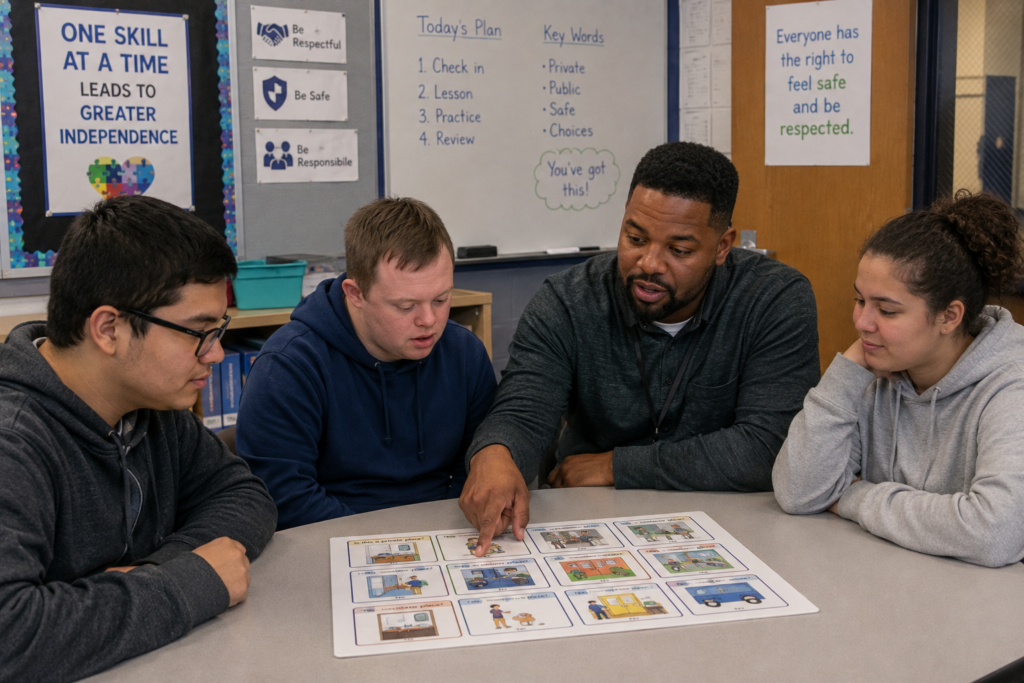
What if we’ve been measuring success too late?
Think about teaching a student to shower independently. Most of us consider the lesson successful when the student can complete every step from beginning to end without assistance. They wash their hair, clean their body, rinse off, dry themselves, apply deodorant, and move on with their day.
While that may be the ultimate goal, teaching one social skill at a time reminds us that success usually begins much earlier.
Success often starts when a student remembers to wash their hair without prompting. Later, they consistently remember to wash their face. Eventually, they add washing under their arms, using soap correctly, drying off, and applying deodorant. Over time, those individual accomplishments become one independent life skill.
That’s how meaningful learning happens.
Students with autism, developmental disabilities, and other learning differences rarely become independent by mastering an entire skill all at once. They become independent by mastering one meaningful step at a time, building confidence with each success before moving on to the next.
That’s one of the core philosophies behind Healthy Relationships. Rather than overwhelming students with complex concepts all at once, we intentionally teach one social skill at a time, allowing each lesson to become another building block toward greater independence.
Teaching One Social Skill at a Time Changes Everything
It’s easy to assume that because we are teaching one lesson, students are learning one skill.
In reality, many of the life skills we teach are made up of dozens of smaller skills working together.
Take showering as an example.
Showering isn’t one skill.
Instead, it’s a collection of many smaller skills that students learn one step at a time.
A student must learn how to wash their hair. Then they learn to wash their face. Next comes washing their arms, under their arms, their legs, and the rest of their body. They learn how much soap to use, how to rinse thoroughly, how to dry themselves, and eventually how to remember deodorant afterward.
If we expect all of those pieces to come together immediately, success can feel impossible for both the student and the educator.
Instead, when we teach one social skill at a time, every small success becomes something worth celebrating.
Remembering to wash your hair today is success.
Adding another step next week is success.
Putting those steps together over time is how independence grows.
Too often, we only celebrate the finished product.
Healthy Relationships encourages us to celebrate the progress that makes the finished product possible.
Students gain confidence because they’re experiencing success instead of constant correction. Educators gain confidence because they’re watching genuine progress happen one step at a time.
That shift changes how we measure learning.
Instead of asking,
“Can this student shower independently?”
we begin asking,
“What is the next meaningful step this student is ready to learn?”
Sometimes that single question changes everything.
Teaching One Social Skill at a Time Builds Independence
One of the biggest misconceptions in social skills instruction is believing that independence happens all at once.
It doesn’t.
Independence grows through hundreds of small successes that build on one another.
Think about teaching students to identify private and public places.
Many educators naturally hope that once students understand the definition of a private place, they’ll immediately recognize every private place they encounter.
For many learners, that’s simply not how learning works.
A student may correctly identify that their bedroom at home with the door closed is a private place.
That’s success.
The next step may be understanding that a public restroom is still a public place, even if no one else appears to be inside.
Later, they may learn that sitting underneath a desk, behind a bookshelf, or in the back seat of a bus doesn’t automatically create privacy simply because other people aren’t immediately visible.
Each of those situations teaches the same concept in a slightly different way.
Each successful understanding becomes another building block.
Over time, students begin recognizing the larger pattern instead of memorizing isolated examples.
That’s how generalization develops.
It’s also why teaching one social skill at a time doesn’t slow learning down.
It actually creates a stronger foundation for long-term independence.
Many educators have heard the saying,
“Inch by inch, life’s a cinch. Yard by yard, life is hard.”
That idea captures this philosophy perfectly.
When we break complex life skills into manageable pieces, students experience success more often. Those successes build confidence. Confidence encourages continued practice. Eventually, those individual skills come together to form the independence we’ve been working toward all along.
Teachable Moments Aren’t Only About Correcting Mistakes
When educators hear the phrase teachable moment, many of us immediately think about correcting a mistake.
A student stood too close to a peer.
Someone interrupted a conversation.
A learner forgot to ask permission before hugging another person.
Those are certainly teachable moments. They deserve our attention because they often involve safety, relationships, or helping students develop better social understanding.
However, some of the most powerful teachable moments happen immediately after students get something right.
Those moments are easy to miss because there isn’t a problem demanding our attention.
Imagine a student correctly identifies that their bedroom at home is a private place.
It’s tempting to move on because they answered correctly.
Instead, what if we simply paused for three seconds?
“That’s exactly right.”
“You identified a private place.”
“Nice job.”
That brief moment of positive reinforcement tells students they successfully understood the concept. It strengthens confidence while increasing the likelihood they’ll recognize the same concept again in another situation.
Sometimes those three seconds become just as valuable as an entire lesson.
Healthy Relationships encourages educators to look for opportunities to reinforce success just as intentionally as we correct mistakes. Both are important. Both help students learn. Yet positive reinforcement often becomes the bridge that carries learning into future situations.
Why Generalization Takes Longer Than We Think
One of the biggest challenges for many students isn’t learning a skill.
It’s recognizing that the same skill applies somewhere new.
Generalization doesn’t happen automatically.
A student who correctly identifies one private place doesn’t automatically understand every private place.
Likewise, identifying one public place doesn’t mean they’ll immediately recognize another.
That’s why we intentionally teach one social skill at a time while gradually expanding where students experience that skill.
For example, a student may first understand that sitting in a classroom is a public place.
Later, they learn that riding the school bus is also a public place.
Eventually, they begin recognizing that standing behind a bookshelf, sitting underneath a desk, or being alone in a public restroom doesn’t automatically create privacy.
Each lesson builds on the previous one.
Each success expands understanding.
Eventually, students begin seeing the concept instead of memorizing individual examples.
That’s the difference between remembering information and truly learning it.
Teaching one social skill at a time before introducing additional layers doesn’t slow progress.
It actually creates stronger learning because students have time to process, practice, and build confidence before moving forward.
Healthy Relationships Was Designed Around Small Steps
Every lesson in Healthy Relationships was intentionally designed around this philosophy.
Rather than asking students to master a large life skill all at once, the curriculum breaks complex topics into meaningful, manageable lessons that build over time.
Whether students are learning about personal hygiene, friendships, healthy boundaries, dating safety, communication, or private versus public, each lesson becomes another opportunity to strengthen one important concept before introducing the next.
That intentional progression helps reduce frustration for both students and educators.
Instead of wondering whether students learned everything, educators can focus on helping students successfully learn the next meaningful step.
If you’d like to better understand the instructional philosophy behind this approach, Purpose of the Healthy Relationships Curriculum explains why the curriculum was intentionally designed around small, teachable concepts that build toward greater independence.
Likewise, View the Healthy Relationships Scope and Sequence provides a clear picture of how individual lessons gradually develop into larger relationship, safety, and daily living skills over time.
One Skill at a Time Today Leads to Greater Independence Tomorrow
There is often pressure in education to keep moving.
Teach the next lesson.
Introduce the next concept.
Check the next box.
However, meaningful learning doesn’t happen because we cover more material. It happens because students truly understand the material we’ve already taught.
That’s why Healthy Relationships encourages educators to slow down just enough to recognize the small victories that eventually become lifelong skills.
Every time a student remembers one more step in a routine…
Every time they correctly identify another public place…
Every time they ask permission before entering someone’s personal space…
Every time they choose an appropriate greeting…
They’re building another layer of independence.
Those moments deserve to be celebrated because they represent genuine progress.
Independence isn’t measured only by the final outcome.
It’s measured by every successful step that makes the final outcome possible.
If you’d like to see how Healthy Relationships intentionally builds these concepts one lesson at a time, watch a short overview of Healthy Relationships to see how the curriculum helps educators build lasting social, relationship, and safety skills through manageable instruction.
If you’re interested in exploring the curriculum yourself, start your free trial and experience how individual lessons gradually build into greater confidence, stronger decision making, and increased independence.
The instructional philosophy behind teaching one concept at a time is also supported by evidence-based practices that encourage breaking complex skills into smaller, teachable components while providing repeated opportunities for guided practice. The IRIS Center at Vanderbilt University offers excellent resources describing how explicit instruction and systematic teaching help students build lasting skills over time.
Teaching One Social Skill at a Time Creates Lasting Independence
As educators, it’s easy to focus on the destination.
We want students to shower independently.
We want them to understand healthy friendships.
We want them to recognize safe and unsafe situations.
We want them to communicate effectively.
Those are all important goals.
However, independence rarely arrives all at once.
It grows through hundreds of successful moments that often last only a few seconds.
A student remembers to wash their hair.
Another identifies a public place correctly.
Someone waits for their turn in a conversation.
A learner remembers to ask before giving someone a hug.
Each success may seem small by itself.
Together, they change lives.
Students don’t become independent by mastering an entire life skill overnight.
They become independent by mastering one meaningful step at a time.
That’s why teaching one social skill at a time isn’t slowing students down.
It’s giving them the strongest possible foundation for lifelong independence.
Author: Rob Anderson, MSW — School Counselor