Teaching healthy relationships to special education students can feel like a big responsibility. Relationships involve friendship, communication, personal space, privacy, boundaries, rejection, consent, dating, safety, and much more. Where does an educator even begin?
A good starting point is to remember that healthy relationships are not one skill.
Students build relationship skills over time. They learn how different people fit into their lives. They learn what makes someone a friend. They practice conversations, recognize boundaries, understand privacy, handle rejection, and learn how to communicate what they want and need.
For some students with developmental disabilities, these ideas may need to be taught directly and concretely. Students may also benefit from seeing skills demonstrated, practicing them, and revisiting them in different situations.
Healthy relationships do not have to be something we simply expect students to figure out.
We can teach them.
What Does Teaching Healthy Relationships Actually Include?
When people hear “healthy relationships,” they sometimes think immediately about dating or romantic relationships.
Those topics matter, especially as students get older. However, relationship education can begin long before dating becomes relevant.
Think about how many relationship decisions happen during an ordinary school day.
Who is a friend?
What makes a friend different from an acquaintance?
How close should I stand to another person?
What information is private?
How do I start a conversation?
What happens when someone does not want to be my friend?
How can I communicate that I do not want to be touched?
What should I do when another person tells me no?
These are relationship skills too.
The American Academy of Pediatrics emphasizes that young people with disabilities should have developmentally appropriate opportunities to learn about relationships as they grow. Its guidance discusses education that extends beyond anatomy and reproduction to include interpersonal relationships, respect, consent, boundaries, and relationship building. The report also describes this education as something that should develop over time rather than happen during a single conversation.
That broader view is helpful when teaching healthy relationships to special education students. Instead of trying to teach “relationships” all at once, educators can identify smaller concepts and build from them.
Start With the People Students Already Encounter
Before students can understand complicated relationships, they may need a way to understand the people already around them.
A student encounters family members, teachers, classmates, neighbors, community members, friends, acquaintances, and strangers. Those people do not all have the same relationship with the student.
That distinction can affect what we say, what we share, how close we stand, and what kinds of interactions are appropriate.
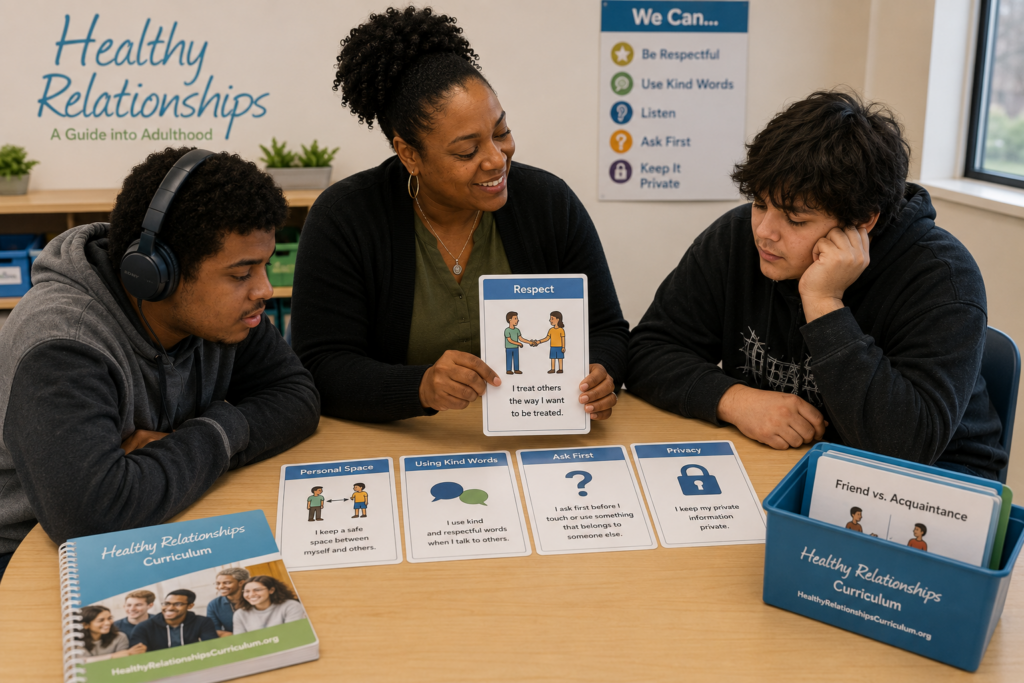
The Healthy Relationships Curriculum begins its Relationship Development module with People I Encounter and Different Types of Relationships. From there, instruction moves into concepts such as friends, acquaintances, bullying, and making friends.
There is a reason to build this foundation.
Imagine teaching a student that it is okay to hug a friend. That guidance becomes confusing if the student does not yet have a clear understanding of who qualifies as a friend.
Likewise, telling a student not to share private information with strangers requires some understanding of who is and is not a stranger.
Relationship categories give students a framework they can use as other skills become more complex.
Make Relationship Concepts Concrete
Relationships are full of unwritten rules.
Many of us learn those rules through years of observation and experience. However, we should not assume every learner will discover them in the same way.
Words such as friendship, privacy, boundaries, consent, and rejection describe ideas that can look different depending on the situation.
Concrete examples can help.
Instead of only telling students to “respect personal space,” show them what appropriate personal space can look like.
Rather than simply explaining that some conversations are private, give examples of public and private topics.
When discussing friendship, help students identify behaviors that may occur in a friendship and compare them with other types of relationships.
Visual supports, videos, demonstrations, examples, and scenarios can turn an abstract concept into something students can see and discuss.
If you want to see how Healthy Relationships combines these different teaching tools, you can see what is included in the Healthy Relationships Curriculum.
Teaching Healthy Relationships to Special Education Students Requires Practice
Knowing the answer is important.
Using the skill is different.
A student might correctly answer a question about personal space and then stand extremely close to someone in the cafeteria. Another learner may identify an appropriate response to rejection during a lesson but struggle when a peer actually says no.
That gap does not necessarily mean the student failed to learn.
It may mean the student needs more opportunities to practice.
Role plays can give learners a chance to try a response before they encounter the situation naturally. Videos can provide examples to watch, pause, discuss, and revisit. Scenario cards can introduce different situations while keeping the underlying concept consistent.
Real-world practice can then help students connect instruction with everyday life.
This matters because the goal is not simply for students to know relationship vocabulary.
We want those skills to become useful.
Teach Communication Alongside Relationships
Relationships depend heavily on communication.
Students may need support learning how to start a conversation, listen to another person, recognize when someone wants to stop talking, adjust voice volume, or decide what information is appropriate to share.
Communication also becomes important when things do not go as planned.
What happens when someone disagrees?
What if another person says no?
How should someone respond when a friend wants something different?
What can a student do if they feel uncomfortable?
The HRC Scope and Sequence reflects this connection. Relationship Development includes lessons on small talk, private talk, personal space, and voice volume. It also introduces rejection and how to respond to rejection safely.
These may seem like separate topics on paper. In real relationships, they overlap constantly.
Teach Boundaries From Both Directions
Students need to learn that their boundaries matter.
They also need to learn that other people’s boundaries matter.
That means relationship education should not focus only on protecting students from unsafe situations. It should also help learners understand how their own behavior affects another person.
For example, a student may need to learn how to say:
“No.”
“Please stop.”
“I don’t want that.”
“I need some space.”
At the same time, students need opportunities to learn what to do when someone else communicates those same messages.
This is one reason teaching healthy relationships to special education students should include both self-advocacy and respect for other people.
As students grow, these concepts can support more advanced discussions about physical affection and consent.
Healthy Relationships Include Handling Rejection
Healthy relationship education cannot only teach what to do when an interaction goes well.
Sometimes another person does not want to talk.
A friendship may change.
Someone may not return romantic interest.
A person may say no to a request.
Those experiences can be disappointing for anyone. Students may need direct instruction about what rejection means and, more importantly, what they can safely do next.
The current Healthy Relationships Scope and Sequence includes What is Rejection? followed by Handling Rejection Safely. It then continues into social media, communication, boundaries, physical affection, consent, and dating as those topics become appropriate for learners.
This progression reinforces an important idea: relationship education is not just about helping students create relationships.
It is also about helping them navigate the complicated moments that happen within them.
Relationship Skills Can Grow With the Learner
Not every relationship topic needs to be taught at once.
In fact, it should not be.
The HRC Scope and Sequence is designed as a reference point rather than a rigid timetable. It emphasizes that educators know their learners best and that many individuals benefit from review and repetition across several years. It also encourages educators to build on prior knowledge as students grow.
You can review the Healthy Relationships Curriculum Scope and Sequence to see how topics can build from foundational concepts toward more complex relationship skills.
That flexibility matters.
One student may be ready to work on identifying friends and acquaintances. Another may need support with personal space. An older learner might be navigating dating, consent, or romantic affection.
The question is not simply, “What grade is the student in?”
We also need to ask, “What does this learner understand, and what do they need next?”
Show Students What Healthy Relationships Can Look Like
Sometimes words are not enough.
A teacher can explain small talk, personal space, boundaries, or appropriate affection. A video can let students see an example unfold.
That is one reason video is used throughout Healthy Relationships.
Students can observe people interacting, talk about what they notice, and connect the example with the concept being taught. Educators can pause when something important happens or replay an interaction when students need another opportunity to see it.
Then students can practice.
If you are new to HRC and want to understand how all of these pieces fit together, watch our video explaining the Healthy Relationships Curriculum.
This is also a useful way to decide whether the teaching approach makes sense for the students you support before exploring the program more deeply.
Families and Caregivers Can Be Part of Relationship Education
Relationship skills do not stay at school.
Students interact with family members, neighbors, friends, community members, coworkers, and people online.
Families and caregivers can provide important information about what students are experiencing outside the classroom. They may also notice skills or challenges that are difficult to see at school.
For example, a student who rarely uses social media during the school day may spend significant time communicating online at home. Another student may demonstrate personal space successfully with school staff but struggle during family or community activities.
Sharing concepts and resources with families can create additional opportunities for students to encounter familiar ideas in different parts of their lives.
That does not mean school and home must look exactly the same.
It means we can help students make connections.
Healthy Relationship Education Should Prepare Students for Real Life
Ultimately, teaching healthy relationships to special education students is not about getting through a list of lessons.
It is about life.
Students are growing up.
Their relationships will change.
They may make new friends, lose friends, meet coworkers, develop romantic interests, communicate online, go on dates, live more independently, or spend more time in their communities.
They will also encounter misunderstandings, disappointment, boundaries, and rejection.
We cannot predict every situation a learner will experience.
We can give them tools.
You Don’t Have to Build Relationship Instruction From Scratch
Knowing what students need is one thing.
Finding the time to create all the materials is another.
A teacher could spend hours searching for a friendship activity, making a personal space visual, finding an appropriate video, writing scenarios about rejection, creating a lesson about consent, developing family materials, and figuring out how to measure progress.
Then another student needs something different.
Healthy Relationships was created to bring these pieces together.
The curriculum provides structured lessons alongside visual supports, videos, role plays, demonstrations, activities, family resources, and tools educators can use to monitor student progress.
More importantly, the topics connect.
Friendship connects with communication.
Communication connects with boundaries.
Boundaries connect with consent.
Rejection connects with safety.
Those connections help relationship education become something more meaningful than a collection of disconnected lessons.
If you want to look inside before making any decisions, you can start a free trial of the Healthy Relationships Curriculum and explore the resources yourself.
Teaching Healthy Relationships Can Start With One Skill
There is a lot we could teach about relationships.
That does not mean we have to teach everything tomorrow.
When teaching healthy relationships to special education students, start with the learner in front of you.
What relationships are part of their life right now?
What do they already understand?
Where are they having difficulty?
What skill could make their relationships safer, healthier, or more successful?
Start there.
Then build.
A conversation about different types of relationships can lead to friendship. Friendship can lead to communication. Communication can lead to boundaries. Those lessons can eventually support discussions about affection, consent, romantic relationships, and dating when they become appropriate.
The important part is that we teach.
If you are wondering where to begin with your students, you do not have to figure it out alone. Schedule time with our team to talk about your learners, your setting, and the relationship skills you are trying to teach.
Healthy relationships matter throughout our lives.
Our students deserve opportunities to learn the skills that can help them build those relationships, understand their own boundaries, respect the boundaries of others, communicate more successfully, and navigate an increasingly complex social world.
Those skills can be taught.
And every learner deserves the opportunity to learn them.