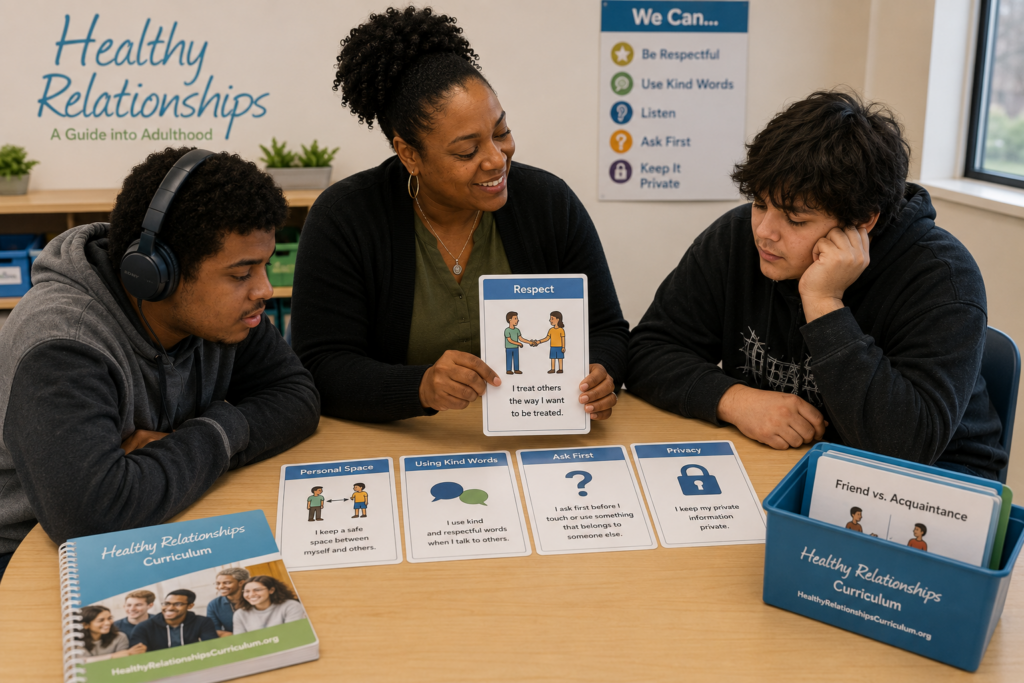
Every educator can probably picture a moment when they realized they needed to teach social skills before a student encountered a challenging situation.
A student stands a little too close to a classmate while waiting in line. Someone blurts out a personal question during a classroom discussion. A learner shares private information with someone they just met, not realizing the situation could become unsafe. Before long, we’re helping students repair hurt feelings, clarify expectations, or navigate a social situation that became much bigger than anyone anticipated.
Those moments are part of teaching, especially when we work with neurodivergent learners or students with developmental disabilities. They often become valuable learning opportunities, and many of us have become quite skilled at recognizing when a student needs guidance.
But it’s also worth asking ourselves an important question: What if the best opportunity to teach that skill happened before the situation ever occurred?
At Healthy Relationships, that’s one of the beliefs that guides everything we do. There will always be teachable moments after a problem arises. We’ve found, however, that some of the most meaningful learning happens long before students need to use the skill independently. When instruction happens proactively, students have the chance to ask questions, practice new skills, and build confidence in an environment where they aren’t worried about getting into trouble or making another mistake.
Teaching social skills proactively isn’t about preventing every mistake. Mistakes are part of learning. Instead, it’s about giving students a stronger foundation before they find themselves navigating increasingly complex social situations on their own.
Learning Looks Different When Students Feel Safe
Think about your own life for a moment.
If you’ve ever had a disagreement with a spouse, a family member, a friend, or a coworker, you probably know that the middle of the conflict isn’t always the best time to solve the problem. When emotions are running high, most of us aren’t thinking clearly. We’re focused on what happened, how we’re feeling, and what comes next. Only after we’ve had an opportunity to settle down are we usually ready to reflect, listen, and truly learn from the experience.
Our students are no different.
When a learner has just experienced an embarrassing social interaction, accidentally crossed someone else’s boundaries, or received corrective feedback, they’re often thinking about consequences. Instead of focusing on instruction, they’re wondering what will happen next. They may be wondering whether they’re in trouble, whether everyone noticed what happened, or how to avoid feeling embarrassed again.
Those concerns are completely understandable.
The challenge is that when emotions become the center of attention, learning often moves into the background. That doesn’t mean we shouldn’t teach in those moments. Sometimes we absolutely should. It simply reminds us that introducing new social concepts before students are under stress often creates a much stronger opportunity for meaningful learning.
We Usually Know Which Skills Students Will Need
One of the greatest advantages educators have is that many of the situations our students will face aren’t surprises.
We know they’ll stand in line at school. We know they’ll eat lunch with peers, participate in community outings, interview for jobs, communicate online, and eventually build relationships throughout adulthood. Educators also know students will need to understand personal space, friendships, boundaries, privacy, hygiene, and healthy decision making if they’re going to navigate those experiences successfully.
If we can anticipate these situations, it raises an important question.
Why would we wait until something goes wrong before introducing the skills that could help students navigate those moments more confidently?
Imagine you were planning a trip across the country. You probably wouldn’t wait until you were pulling out of the driveway to decide how you were getting there. You’d look at a map, plan your route, and prepare for the journey ahead. Teaching social skills works much the same way. We already know many of the situations our students will encounter. Preparing them before those moments occur simply gives them a better roadmap for success.
Proactive instruction gives learners something incredibly valuable: the opportunity to succeed before the stakes feel high. Instead of learning while they’re worried about making another mistake, students have time to practice, ask questions, and develop confidence in a supportive environment where mistakes become part of the learning process rather than the center of it.
That shift may seem small, but over time it changes the entire learning experience.
Teaching Social Skills Means Teaching Smaller Skills First
One of the biggest misconceptions about social skills is that they’re single skills.
In reality, most of the skills we teach are made up of many smaller skills that work together.
Take friendship as an example. We sometimes talk about “making friends” as though it’s a single lesson, but healthy friendships involve many different skills working together. Students learn how to communicate, respect boundaries, recognize another person’s perspective, build trust, solve disagreements, and understand that not every person they enjoy spending time with has the same role in their lives.
Teaching students the difference between a friend and an acquaintance is one example of helping learners understand those different roles before they find themselves in a confusing or potentially unsafe situation.
The same idea applies to many of the topics educators teach every day.
Understanding personal hygiene isn’t simply about taking a shower. It includes recognizing when hygiene is needed, understanding why it matters, developing routines, using products correctly, and practicing those routines consistently enough that they become part of everyday life.
When we begin looking at social skills this way, it changes how we teach them. Instead of expecting students to master a complex concept all at once, we can intentionally teach the smaller skills that eventually come together to support greater independence.
Repetition Is What Holds Learning Together
Educators often talk about building blocks.
It’s a helpful analogy because every new skill gives students something they can build upon. As learners grow, those individual skills begin connecting to one another, creating a stronger understanding of themselves and the world around them.
But there is another analogy that I think captures the learning process even better.
Imagine building a brick wall.
The bricks are important. Without them, there isn’t a wall. Each brick represents a new concept, a new lesson, or another opportunity for growth.
But if you’ve ever looked closely at a brick wall, you know that the strength of the wall doesn’t come from the bricks alone.
It comes from the mortar that holds everything together.
The same is true when we teach social skills.
Individual lessons matter, but lasting learning doesn’t happen simply because students heard a lesson once. It happens because those lessons are reinforced through repetition, consistency, practice, and opportunities to apply them in different situations. Those experiences become the “mortar” that connects one lesson to the next until students begin using those skills more independently.
That’s why we often say that teaching isn’t simply about presenting information. It’s about creating enough meaningful opportunities for students to connect those individual lessons until they become part of everyday life.
This is especially important for many neurodivergent learners.
A developmental delay doesn’t mean something is broken. Our students don’t need to be fixed. They simply benefit from instruction that is often more explicit, more concrete, and reinforced over time. When we begin thinking about repetition as one of our greatest instructional tools rather than simply repeating ourselves, it changes how we approach teaching altogether.
One Situation Doesn’t Automatically Teach the Next
One of the greatest challenges many educators observe is generalization.
Adults often transfer experiences from one setting to another without even realizing they’re doing it. Many of our students need those connections taught much more explicitly.
For example, a student may learn about personal space while waiting in line at school and do an excellent job applying that skill every day in the cafeteria. Then that same student visits an amusement park, attends a sporting event, or rides public transportation and suddenly struggles to know what appropriate personal space looks like in a completely different environment.
To us, those situations may seem obviously related.
To the learner, they may feel completely different.
That’s why proactive instruction extends beyond teaching a skill once. It also means creating opportunities to talk about how the same skill may look different depending on the environment, the people involved, and the expectations of that setting.
Helping students make those connections is often just as important as introducing the skill itself.
Teach Social Skills Through Small Everyday Conversations
When educators hear the phrase “teach social skills,” it’s easy to imagine adding another lesson to an already full schedule.
In reality, some of the most meaningful instruction happens in moments that only take a few minutes.
It might be a conversation before walking into the cafeteria.
A reminder before students leave for a community outing.
A discussion before work based learning begins.
A role play before students practice introducing themselves to someone new.
Those brief, intentional conversations often become powerful because they happen before students need the skill. Instead of reacting to a mistake, we’re preparing students for success. That small shift allows instruction to feel encouraging rather than corrective, giving students the confidence to apply what they’ve learned when the opportunity arises.
Supporting Teachers, Not Giving Them More To Do
Every educator already understands that social skills matter.
The challenge has never been convincing teachers that these lessons are important.
The challenge is time.
Teachers are balancing academic instruction, IEP implementation, progress monitoring, behavior support, family communication, documentation, meetings, and countless responsibilities throughout every school day. Adding one more thing to that list isn’t realistic.
That’s why proactive instruction isn’t about doing more.
It’s about teaching with intention.
Sometimes spending just a few minutes preparing students before an activity can prevent repeated corrections later. A short conversation before a community outing, a visual reminder before lunch, or a role play before a classroom discussion can often have a greater impact than repeatedly addressing the same concern after it happens.
When proactive instruction becomes part of everyday teaching instead of something we only do after problems arise, students are given more opportunities to experience success before challenges become barriers.
Helping Students Build Confidence Before They Need It
At Healthy Relationships, we believe the best way to teach social skills isn’t to wait until something goes wrong.
Mistakes are part of learning.
The goal is to help students develop the knowledge, confidence, and decision making skills they’ll need before they find themselves navigating increasingly complex relationships and situations on their own.
When we teach social skills proactively, we’re doing much more than reducing challenging situations in the classroom.
We’re helping students become more independent.
We’re helping them build healthier relationships.
We’re helping them make safer decisions.
And perhaps most importantly, we’re helping them develop the confidence to participate more fully in school, at work, in their communities, and throughout adulthood.
Those are skills that extend far beyond the classroom.
They’re life skills.
Continue Building Social Skills with Healthy Relationships
Healthy Relationships helps educators proactively teach relationship skills, social safety, personal boundaries, hygiene, self advocacy, healthy decision making, and independence through structured lessons, engaging videos, visual supports, assessments, and professional development designed specifically for neurodivergent learners and students with developmental disabilities.
Whether you’re introducing these concepts for the first time or reinforcing them throughout the school year, Healthy Relationships provides practical tools that help students build confidence one skill at a time. Because when students have opportunities to learn social skills before they need them, they’re not just preparing for the next school day. They’re preparing for greater independence throughout life.
Author: Annie Smith, M. Ed. — Behavioral Health Specialist
Healthy Relationships is used by educators, therapists, schools, residential programs, and service providers across 43 states to teach safety, relationships, independence, and daily living skills to individuals with developmental disabilities.